Company strategy
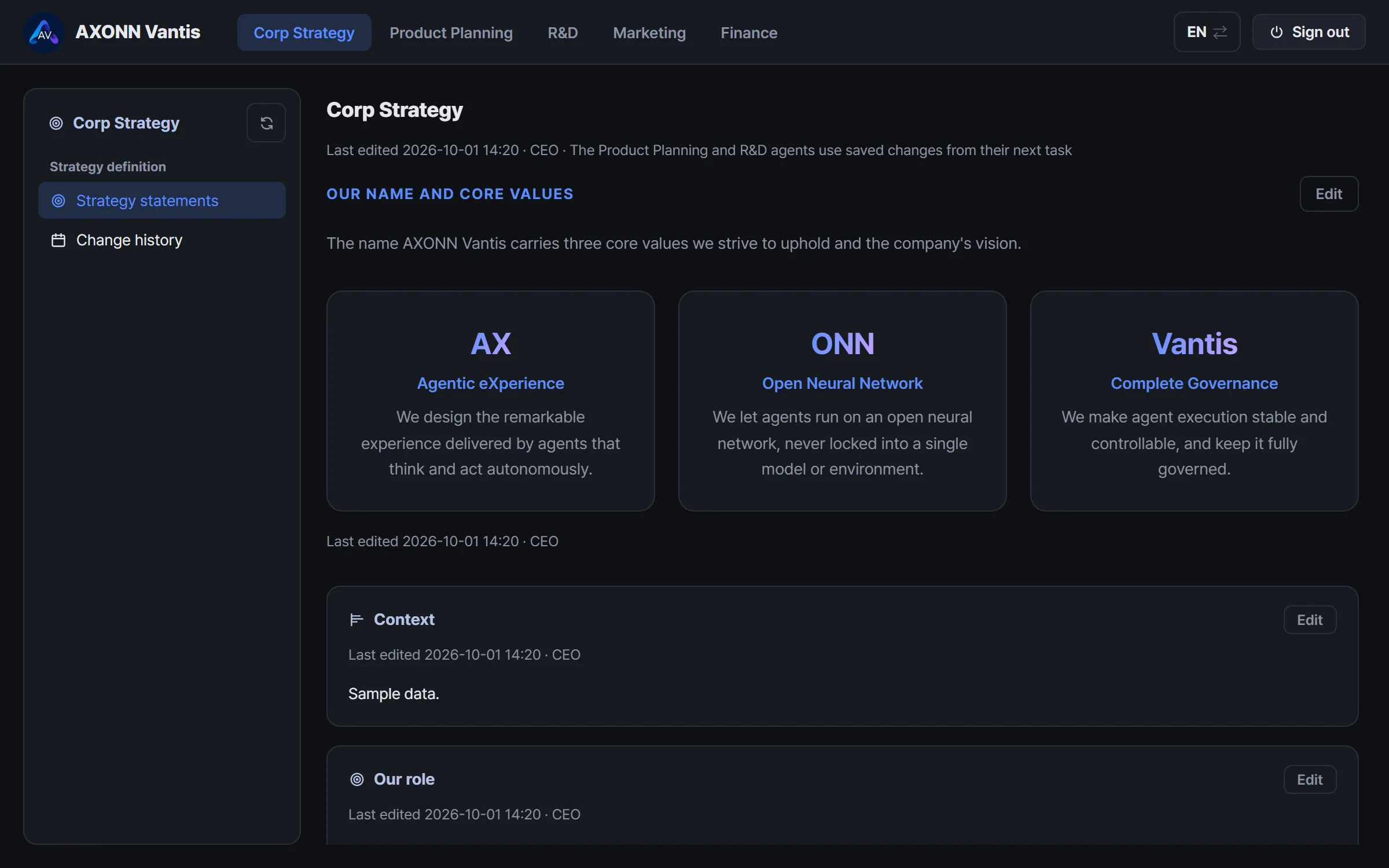
The space where the executive writes and maintains the strategy.It is not an agent.It is the baseline every agent follows.

A company operations service powered by dedicated AI agents
The executive writes the company's vision, role, and product direction into the strategy document, and every department agent works from it starting with its next task.When the strategy changes, there is no need to reconfigure each agent.
Department agents carry out their work on a set schedule and report the results.The executive can focus on judgment and decisions instead of repeating instructions.
Agents propose, with evidence.Approving, revising, or rejecting is decided by a person, and every decision is recorded and traceable.
The decisions, measurements, and retrospectives that come out of the work accumulate as knowledge assets.Later work starts from that knowledge, so the organization's capability grows as it operates.
Dedicated agents are set up around the work each department does.The following are representative examples.
The screens show the service app AXONN Vantis actually uses, presented as mockups.
The space where the executive writes and maintains the strategy.It is not an agent.It is the baseline every agent follows.
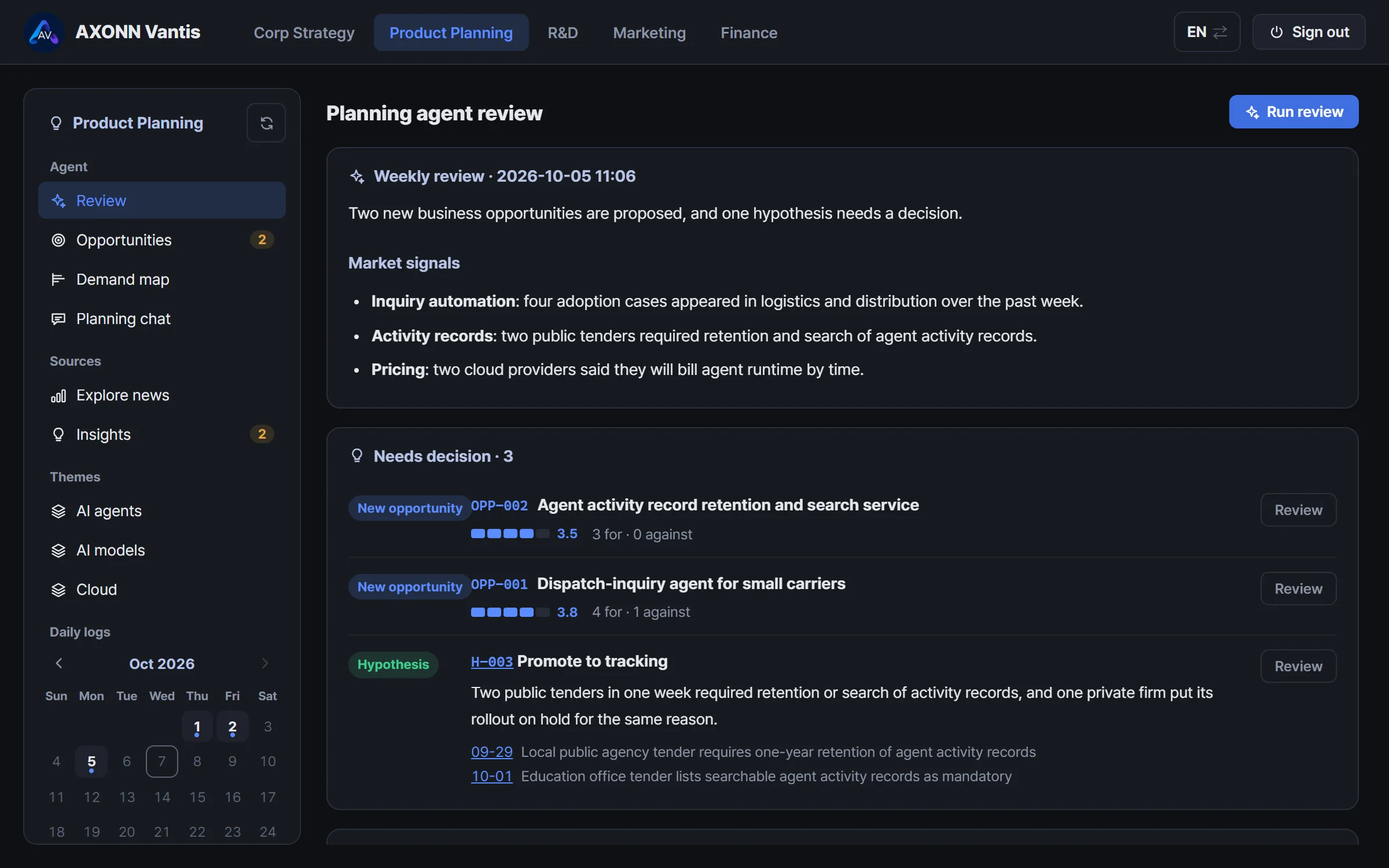
Analyzes market trends every day, maps demand and supply, and proposes business opportunities with the evidence behind them.It tracks hypotheses against leading indicators.
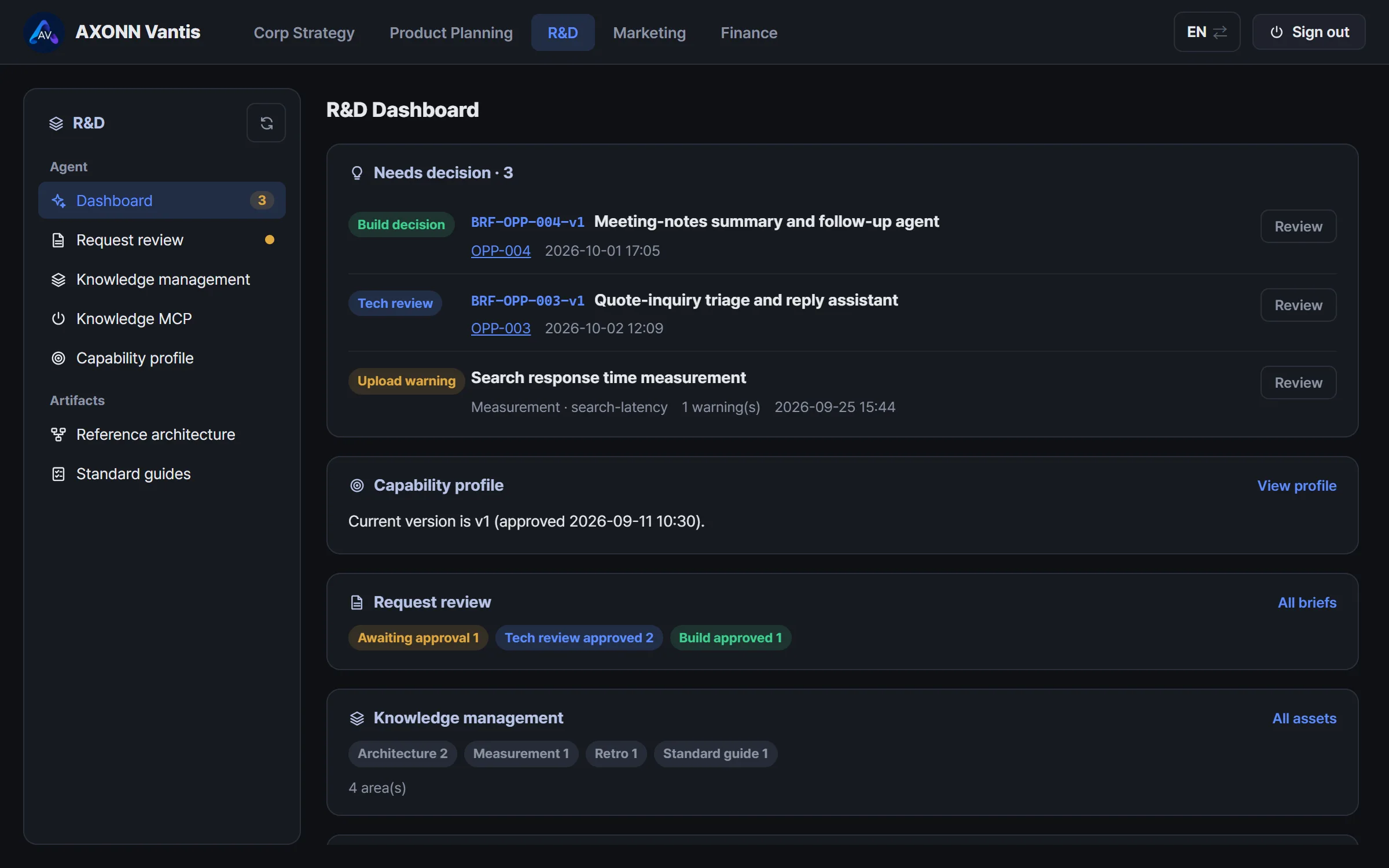
Runs the harness that applies the company's development governance to coding agents.It turns an approved business opportunity into a development brief and hands it to coding agents, and it manages standards, architecture decisions, measurements, and retrospectives as knowledge assets.Coding agents do the building, reading the company's standards and knowledge over MCP and applying them as they work.
Maintains the company's public messaging, prepares content from material the other departments supply, and publishes it once approved.AI also handles customer management, automated email campaigns, and responses to inquiries.
Departments that differ from company to company, such as finance, are designed together during adoption consulting.
Leave a development task entirely to a coding agent's own judgment, and the output arrives fast.But that output is likely to fall short of the development governance your company already has.The coding agent works from general knowledge, without knowing the standards the company has set, the architecture it has already reviewed, or the data from past experiments worth referring to.
That is why applying a harness to coding agents matters.A harness is the framework that has coding agents read the company's development governance and work within it.It keeps the coding agent's speed and makes the output follow the company's baseline.In AI Native Company Pack, the R&D agent runs this harness.
The harness provides coding agents with three development assets the company already holds.
There is a standard for each area of development.AXONN Vantis governs five areas: web UI/UX, agent and model calls, API and server, security and secrets management, and delivery and operations.Every rule is marked required or recommended and carries its rationale.Standards are versioned, and a new version takes effect only after the executive approves it.
Structures we have built and run are kept as reference architectures.Each comes with decision records: what was chosen, why, and how it held up in operation.
Data from past experiments worth referring to, such as cost, processing time, and accuracy, is kept together with the conditions it was measured under.Coding agents start a design from that data, not from estimates.
From the request to the completion report, development governance is applied at each stage of a coding agent's work.
The development brief specifies the standards and versions to follow and provides the related prior knowledge: architecture, measurements, and retrospectives.
The repository's instructions have the coding agent read the latest version of the applicable standards first.
The coding agent queries standards, reference architectures, measurements, and the design checklists drawn from retrospectives over MCP, with read-only access.
Rules that can be verified automatically are enforced by automated checks.If a check fails, deployment is blocked.
The coding agent reports the standards and versions it complied with, and any recommended rule it did not apply, with the rationale.Exceptions to required rules require the executive's approval.
Coding agents start by reading the standards, the reviewed architecture, and the measurements.Whether they followed them is confirmed by automated checks and the work report, and kept on record.
Development governance does not live in any one coding agent's settings.It lives in one place the company manages, so whichever coding agent takes the job reads the same standards.
Publish a new version, and every coding agent follows it from its next task.
New measurements and retrospectives from the build go back into the knowledge assets and become the baseline for the next one.
Development governance differs from company to company.During adoption consulting we learn your standards, your technology base, and the way you build, and decide together what goes into the harness.
AI Native Company Pack separates the domain of people, who set direction and make decisions, from the domain of agents, who work in that direction.The two are connected by the strategy document and the approval process.
Executive — Direction & Decisions
Company Strategy — Single Source
The strategy document every agent follows
Department Agents — Execution Domain
Shared Foundation
Cloudflare Global Network
Where the service app runs
External coding agents
It runs on Cloudflare's global network.There are no servers to build or operate.
Agents and data are divided by department.Each department has its own tools, scheduled jobs, and permissions.
One department's output, once approved by a person, becomes the next department's work.For example, when the executive approves technical validation of a business opportunity found by the product planning agent, the R&D agent is notified automatically and writes the development brief.
Scheduled and long-running jobs execute step by step.If a step fails, the job resumes from that step.Steps are idempotent, so running the same step again neither changes the result nor duplicates it.
Only people who sign in with a company account get in.External coding agents get read-only access to knowledge.
Coding agents do the building, and the harness applies the company's development governance to them.The company manages standards and knowledge assets centrally, and coding agents read and follow them before they work.Rules that can be verified automatically are checked before deployment.
We learn your company's work and goals and work out the details of the solution build.
We report the consulting results, the tailored solution proposal, and the schedule.
If you decide to adopt, we sign a formal supply agreement.
We build the solution tailored to your company on the proposed schedule.